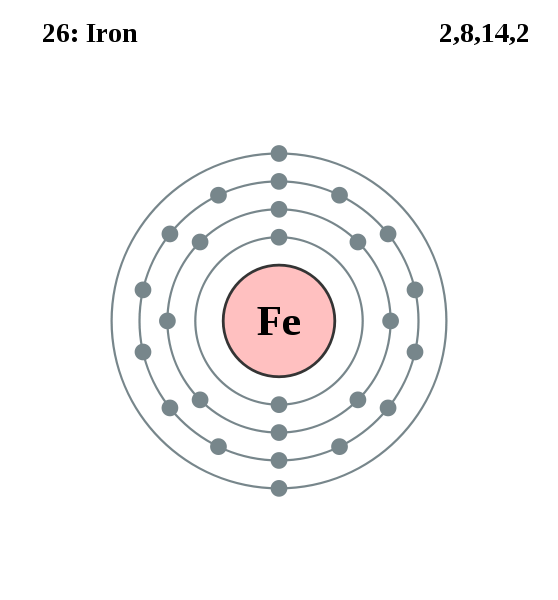
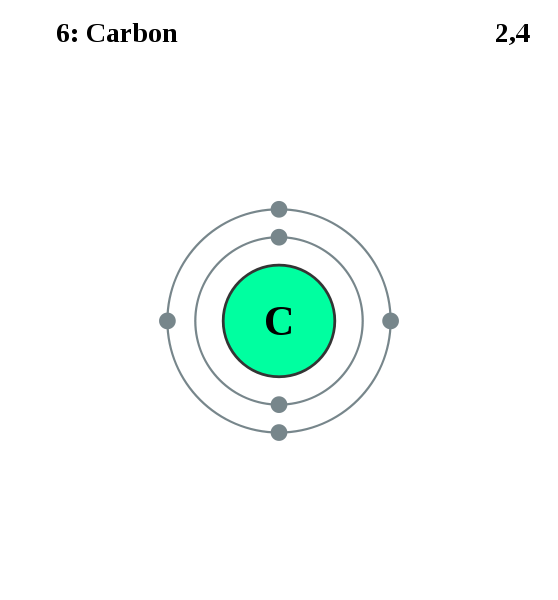
It is interesting that steel is a mixture of 99% iron and 1% carbon. It did not make new molecules, but a mixture where the smaller carbon atoms fitted into the gaps between the larger iron ones. Traditionally the Japanese steel sword was made by taking a small quantity of iron and beating it out when heated, and placing it in a 'bath' of carbon made from wood. This heated it, and also gave the iron a coating of carbon one molecule thick. It was then beaten out (to double the length and width) before being folded in half, the process being repeated enough times to give the required 1% of carbon. This steel does not require tempering (in cold water) and will not rust. We are still learning about the properties of all elements, including iron and carbon.

Graphite was used in the first atomic pile to absorb neutrons.

 To determine the number of atoms in 1 gram, it's a simple conversion. Start with the mass (g), get the number of mols by dividing by the atomic weight (g/mol), and then the number of atoms by avogadro's number (6.02x10^23 atoms/mol).

So.. (1.0g Fe) / (55g/mol Fe) x (6.02x10^23 atoms/mol) = 1.1x10^22.

1 ounce = aprox 28.35 grams

8 ounces = aprox 226.8 grams


Carbon

Carbon combines with some metals at high temperatures to form metallic carbides, such as the iron carbide cementite in steel, and tungsten carbide, widely used as an abrasive and for making hard tips for cutting tools.

As of 2009, graphene appears to be the strongest material ever tested.[17] However, the process of separating it from graphite will require some technological development before it is economical enough to be used in industrial processes.[18]

 There are several allotropes of carbon of which the best known are graphite, diamond, and amorphous carbon.[12] The physical properties of carbon vary widely with the allotropic form. For example, diamond is highly transparent, while graphite is opaque and black. Diamond is among the hardest materials known, while graphite is soft enough to form a streak on paper (hence its name, from the Greek word "to write"). Diamond has a very low electrical conductivity, while graphite is a very good conductor. Under normal conditions, diamond has the highest thermal conductivity of all known materials.

 Graphene

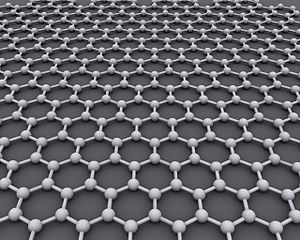
Graphene is an allotrope of carbon, whose structure is one-atom-thick planar sheets of sp2-bonded carbon atoms that are densely packed in a honeycomb crystal lattice.[1] The term graphene was coined as a combination of graphite and the suffix -ene by Hanns-Peter Boehm,[2] who described single-layer carbon foils in 1962.[3] Graphene is most easily visualized as an atomic-scale chicken wire made of carbon atoms and their bonds. The crystalline or "flake" form of graphite consists of many graphene sheets stacked together.

The carbon-carbon bond length in graphene is about 0.142 nanometers.[4] Graphene sheets stack to form graphite with an interplanar spacing of 0.335 nm, which means that a stack of three million sheets would be only one millimeter thick. Graphene is the basic structural element of some carbon allotropes including graphite, charcoal, carbon nanotubes and fullerenes. It can also be considered as an indefinitely large aromatic molecule, the limiting case of the family of flat polycyclic aromatic hydrocarbons.

The Nobel Prize in Physics for 2010 was awarded to Sir Andre Geim and Sir Konstantin Novoselov "for groundbreaking experiments regarding the two-dimensional material graphene".[5]

 Electronic properties

Graphene differs from most conventional three-dimensional materials. Intrinsic graphene is a semi-metal or zero-gap semiconductor. Understanding the electronic structure of graphene is the starting point for finding the band structure of graphite. It was realized as early as 1947 by P. R. Wallace[72] that the E-k relation is linear for low energies near the six corners of the two-dimensional hexagonal Brillouin zone, leading to zero effective mass for electrons and holes. [73] Due to this linear (or “conical") dispersion relation at low energies, electrons and holes near these six points, two of which are inequivalent, behave like relativistic particles described by the Dirac equation for spin 1/2 particles.[74][75] Hence, the electrons and holes are called Dirac fermions, and the six corners of the Brillouin zone are called the Dirac points.[74] The equation describing the E-k relation is E = \hbar v_F\sqrt{k_x^2+k_y^2}; where the Fermi velocity vF ~ 106 m/s.[75]
Bi-dimensional space

Bi-dimensional space is a geometric model of the planar projection of the physical universe in which we live. The two dimensions are commonly called length and width. Both directions lie in the same plane.

In physics and mathematics, a sequence of n numbers can be understood as a location in n-dimensional space. When n = 2, the set of all such locations is called 2-dimensional Euclidean space or bi-dimensional Euclidean space.

In physics, our bi-dimensional space is viewed as a planar representation of the space in which we move, described as bi-dimensional space or two-dimensional space.

The most popular coordinate systems are the Cartesian coordinate system, the polar coordinate system and the geographic coordinate system.

 Graphene is an atomic-scale honeycomb lattice made of carbon atoms.

 sp2 hybrids

Other carbon based compounds and other molecules may be explained in a similar way as methane. Take, for example, ethene (C2H4). Ethene has a double bond between the carbons.

For this molecule, carbon will sp2 hybridise, because one π (pi) bond is required for the double bond between the carbons, and only three σ bonds are formed per carbon atom. In sp2 hybridisation the 2s orbital is mixed with only two of the three available 2p orbitals:


C^{*}\quad
\frac{\uparrow\downarrow}{1s}\;
\frac{\uparrow\,}{sp^2}\;
\frac{\uparrow\,}{sp^2}
\frac{\uparrow\,}{2p}

forming a total of 3 sp2 orbitals with one p-orbital remaining. In ethylene (ethene) the two carbon atoms form a σ bond by overlapping two sp2 orbitals and each carbon atom forms two covalent bonds with hydrogen by ssp2 overlap all with 120° angles. The π bond between the carbon atoms perpendicular to the molecular plane is formed by 2p–2p overlap. The hydrogen–carbon bonds are all of equal strength and length, which agrees with experimental data.

The amount of p-character is not restricted to integer values; i.e., hybridisations like sp2.5 are also readily described. In this case the geometries are somewhat distorted from the ideally hybridised picture. For example, as stated in Bent's rule, a bond tends to have higher p-character when directed toward a more electronegative substituent.


Make a free website with Yola