In chemistry, valence bond (VB) theory is one of two basic theories, along with molecular orbital (MO) theory, that were developed to use the methods of quantum mechanics to explain chemical bonding. It focuses on how the atomic orbitals of the dissociated atoms combine to give individual chemical bonds when a molecule is formed. In contrast, molecular orbital theory has orbitals that cover the whole molecule.[1]
Earlier we said that water (H2O) is heavier than its equivalent of oxygen and Hydrogen, because it is more densly packed.
While this is not directly related to sub atomic particles (protons and neutrons), it is interesting to note that nuclear forces, (in this case valence bonding) can be said to increase weight (mass). This is a contentious statement because in fact strictly speaking the mass of three atoms remains the same whether they are atoms or a molecule, but if the energy of the atoms is increased (by bonding) then we can say the mass increases.(P=MV) x= MxV, if velocity is doubled for the same mass, the total momentum is doubled x=Mx2V, 2X=MxV(new).
. In fact energy is released when Hydrogen and Oxygen combine to make water, but that is outside the atom, we don't know what is happening inside the nucleii.
Explanation of the shape of water
Commonly, the hybridization of the oxygen in water is described as sp3 following the guidelines of VSEPR and the tetrahedral electron geometry it implies.[5] In order for this to be true, the two electron pairs would be in equal-energy, symmetrical, sp3 hybridised orbitals (two electron-pairs and two hydrogen atoms making the tetrahedron). However, molecular orbitals calculations give orbitals which reflect the symmetry of the molecule.[6] One of the two lone pairs is in a pure p-type orbital, with its electron density perpendicular to the H-O-H framework.[6] The other lone pair is an orbital that is close to an sp2-type orbital that is in the same plane as the H-O-H bonding. It is not a purely sp2-type orbital, but is extra rich in s-character.[6] Photoelectron spectra confirm the presence of two different energies for the nonbonded electrons.[7]
In contrast, the orbitals used to make the O-H bonds are close to sp2 hybrids, but are extra p-rich.[8] However, molecular orbital theory does not give two equivalent bonds, but two delocalised orbitals which are in-phase and out-of-phase combinations of the H-O bond orbitals.[6] It has been argued that it is this change in the mixing of the orbitals that is responsible for the compression of the H-O-H angle down to the experimental 104.5 degrees, not some change in the repulsion of electrons.[8] However, if the molecular orbitals are localised, leaving the total wave function unaltered, one obtains two equivalent lone pairs and two equivalent bonds.[9]
An accurate prediction of the bond angle requires however that polarisation d functions be added to the molecular orbital calculation.[10] Thus while VSEPR and its application to hybridisation predicts the correct atomic framework for water, it may do so for the wrong reason.
In chemistry, hybridisation (or hybridization) is the concept of mixing atomic orbitals to form new hybrid orbitals suitable for the qualitative description of atomic bonding properties. Hybridised orbitals are very useful in the explanation of the shape of molecular orbitals for molecules. It is an integral part of valence bond theory. Although sometimes taught together with the valence shell electron-pair repulsion (VSEPR) theory, valence bond and hybridization are in fact not related to the VSEPR model.[1]
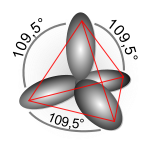
Four sp3 orbitals.

Three sp2 orbitals
Atomic orbital
An atomic orbital is a mathematical function that describes the wave-like behavior of either one electron or a pair of electrons in an atom.[1] This function can be used to calculate the probability of finding any electron of an atom in any specific region around the atom's nucleus. The term may also refer to the physical region where the electron can be calculated to be, as defined by the particular mathematical form of the orbital.[2]
Atomic orbitals are mathematical functions that depend on the coordinates of only one electron. They describe the wave-like nature of this electron in any energy state. They can be the hydrogen-like "orbitals" which are exact solutions to the Schrödinger equation for a hydrogen-like "atom" (i.e., the hydrogen atom or any ion formed by one electron and a nucleus). Alternatively, atomic orbitals refer to functions that depend on the coordinates of one electron (i.e. orbitals) but are used as starting points for approximating wave functions that depend on the simultaneous coordinates of all the electrons in an atom or molecule. The coordinate systems chosen for atomic orbitals are usually spherical coordinates (r,θ,φ) in atoms and cartesians (x,y,z) in poly-atomic molecules.