All light travels at the speed of light 'c' where: -
c = λ x f
With 'f' as the frequency of the light.
Einstein showed that light may also be modelled as small quanta or photons of energy 'E' given by: -
E = hf
Where 'h' is Planck's constant.
The Planck constant (denoted h), also called Planck's constant, is a physical constant reflecting the sizes of energy quanta in quantum mechanics. It is named after Max Planck, one of the founders of quantum theory, who discovered it in 1900. Classical statistical mechanics requires the existence of h (but does not define its value).[2]
The Planck constant was first described as the proportionality constant between the energy (E) of a photon and the frequency of its associated electromagnetic wave (ν). This relation between the energy and frequency is called the Planck relation or the Planck–Einstein equation:
Since the frequency ν, wavelength λ, and speed of light c are related by λν = c, the Planck relation can also be expressed as
In 1923, Louis de Broglie generalized this relation by postulating that the Planck constant represents the proportionality between the momentum and the quantum wavelength of not just the photon, but any particle. This was confirmed by experiments soon afterwards.
In applications where frequency is expressed in terms of radians per second ("angular frequency") instead of cycles per second, it is often useful to absorb a factor of 2π into the Planck constant. The resulting constant is called the reduced Planck constant or Dirac constant. It is equal to the Planck constant divided by 2π, and is denoted ħ ("h-bar"):
The energy of a photon with angular frequency ω, where ω = 2πν, is given by

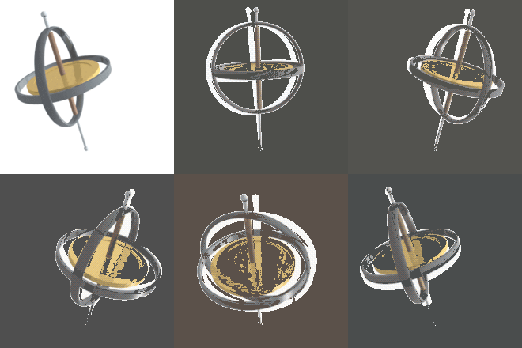
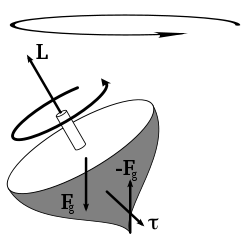
Precession of a gyroscope
Precession is a change in the orientation of the rotation axis of a rotating body. It can be defined as a change in direction of the rotation axis in which the second Euler angle (nutation) is constant. In physics, there are two types of precession: torque-free and torque-induced.
In astronomy, "precession" refers to any of several slow changes in an astronomical body's rotational or orbital parameters, and especially to the Earth's precession of the equinoxes. See Precession (astronomy).
Energy of a photon in Joule-seconds
| 6.62606957(29)×10−34 | J·s[1] |
The joule-second is a unit equal to a joule multiplied by a second, used to measure action or angular momentum. The joule-second is the unit used for Planck's constant.
In SI base units, the joule-second is
.

Action
In physics, action is an attribute of the dynamics of a physical system. It is a mathematical functional which takes the trajectory, also called path or history, of the system as its argument and has a real number as its result. Action has the dimension of energy × time, and its unit is joule-seconds in the International System of Units (SI). Generally, the action takes different values for different paths. Classical mechanics postulates that the path actually followed by a physical system is that for which the action is minimized, or, more strictly, is stationary. The classical equations of motion of a system can be derived from this principle of least action. The stationary action formulation of classical mechanics extends to quantum mechanics in the Feynman path integral formulation, where a physical system follows simultaneously all possible paths with amplitudes determined by the action.
If the action is represented as an integral over time, taken along the path of the system between the initial time and the final time of the development of the system,
the integrand,
, is called the Lagrangian. For the action integral to be well defined the trajectory has to be bounded in time and space.
Angular Momentum
In physics, angular momentum, moment of momentum, or rotational momentum[1][2] is a vector quantity that can be used to describe the overall state of a physical system. The angular momentum L of a particle with respect to some point of origin is
where r is the particle's position from the origin, p = mv is its linear momentum, and × denotes the cross product.
Since my whole solution to the problem of gravity and electromagnetic radiation is in angular momentum, we are going to devote a little more time to understanding this before going on the the construction of atoms.
If gravity is angular momentum, and eliminates any need to search for "gravity waves" as distinct from any other sort of electromagnetic radiation then this is indeed a breakthrough in defining Einstein's missing "unified field theory".

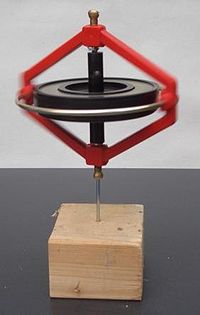
This gyroscope remains upright while spinning due to its angular momentum.
A quantum gyroscope is a very sensitive device to measure angular rotation based on quantum mechanical principles. The first of these has been built by Richard Packard and his colleagues at the University of California, Berkeley. The extreme sensitivity means that theoretically a larger version could detect effects like minute changes in the rotational rate of the Earth.
In 1962, Cambridge University physicist Brian Josephson hypothesized that an electrical current could travel between two superconducting materials even when they were separated by a thin insulating layer. The term Josephson effect has come to refer generically to the different behaviors that occur in any two weakly connected macroscopic quantum systems—systems composed of molecules that all possess identical wavelike properties. Among other things, the Josephson effect means that when you connect two superfluids (zero friction fluids) using a weak link and pressure is applied to the superfluid on one side of a weak link, the fluid will oscillate from one side of the weak link to the other.
The Josephson effect is the phenomenon of supercurrent — i.e. a current that flows indefinitely long without any voltage applied — across a device known as a Josephson junction (JJ), and consisting in two superconductors coupled by a weak link. The weak link can consist of a thin insulating barrier (known as a superconductor–insulator–superconductor junction, or S-I-S), a short section of non-superconducting metal (S-N-S), or a physical constriction that weakens the superconductivity at the point of contact (S-s-S). The term is named after British physicist Brian David Josephson, who predicted in 1962 the mathematical relationships for the current and voltage across the weak link.[1][2] Before his prediction it was only known that normal (i.e. non-superconducting) electrons can flow through an insulating barrier, by means of quantum tunneling. Josephson was the first to predict the tunneling of superconducting Cooper pairs. For this work, Josephson received the Nobel prize in physics in 1973.[3] Josephson junctions have important applications in quantum-mechanical circuits, such as SQUIDs, superconducting qubits and RSFQ digital electronics.
A Dayem bridge is a thin-film variant of the Josephson junction in which the weak link consists of a superconducting wire with dimensions on the scale of a few micrometres or less.[4][5]