Energy is equal to mass times velocity;
where mass is equal to any mass (in kilograms) and
velocity is equal to c squared, (the speed of light, or the distance covered by (displacement of) a photon divided by the unit time, multiplied by itself (the distance travelled by a photon divided by unit time).
Or;
Volume divided by mass is equal to energy;
Where volume is the wavelength of light and
mass is equal to mass of one photon.
What do you think the correct relationship between mass and energy is if energy is equal to mass times velocity, (the more velocity an object has, the more energy it has)?
All light travels at the speed of light 'c' where: -
c = λ x f
With 'f' as the frequency of the light.
Einstein showed that light may also be modelled as small quanta or photons of energy 'E' given by: -
E = hf
Where 'h' is Planck's constant.
Velocity
In physics, velocity is speed in a given direction. Speed describes only how fast an object is moving, whereas velocity gives both the speed and direction of the object's motion. To have a constant velocity, an object must have a constant speed and motion in a constant direction. Constant direction typically constrains the object to motion in a straight path. A car moving at a constant 20 kilometers per hour in a circular path does not have a constant velocity. The rate of change in velocity is acceleration. Velocity is a vector physical quantity; both magnitude and direction are required to define it. The scalar absolute value (magnitude) of velocity is speed, a quantity that is measured in metres per second (m/s or ms−1) when using the SI (metric) system.
For example, "5 metres per second" is a scalar and not a vector, whereas "5 metres per second east" is a vector. The average velocity v of an object moving through a displacement
during a time interval (Δt) is described by the formula:
The rate of change of velocity is acceleration – how an object's speed or direction of travel changes over time, and how it is changing at a particular point in time.
In Newtonian mechanics, the kinetic energy (energy of motion), EK, of a moving object is linear with both its mass and the square of its velocity:
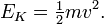
The kinetic energy is a scalar quantity.
Angular Momentum
In physics, angular momentum, moment of momentum, or rotational momentum[1][2] is a vector quantity that can be used to describe the overall state of a physical system. The angular momentum L of a particle with respect to some point of origin is
where r is the particle's position from the origin, p = mv is its linear momentum, and × denotes the cross product.
The angular momentum of a system of particles (e.g. a rigid body) is the sum of angular momenta of the individual particles. For a rigid body rotating around an axis of symmetry (e.g. the fins of a ceiling fan), the angular momentum can be expressed as the product of the body's moment of inertia I (a measure of an object's resistance to changes in its rotation rate) and its angular velocity ω:
In this way, angular momentum is sometimes described as the rotational analog of linear momentum.
Angular momentum is conserved in a system where there is no net external torque, and its conservation helps explain many diverse phenomena. For example, the increase in rotational speed of a spinning figure skater as the skater's arms are contracted is a consequence of conservation of angular momentum. The very high rotational rates of neutron stars can also be explained in terms of angular momentum conservation. Moreover, angular momentum conservation has numerous applications in physics and engineering (e.g. the gyrocompass).
Time
Time is a part of the measuring system used to sequence events, to compare the durations of events and the intervals between them, and to quantify rates of change such as the motions of objects.[1] The temporal position of events with respect to the transitory present is continually changing; events happen, then are located further and further in the past. Time has been a major subject of religion, philosophy, and science, but defining it in a non-controversial manner applicable to all fields of study has consistently eluded the greatest scholars. A simple definition states that "time is what clocks measure".
Time is one of the seven fundamental physical quantities in the International System of Units. Time is used to define other quantities — such as velocity — so defining time in terms of such quantities would result in circularity of definition.[2] An operational definition of time, wherein one says that observing a certain number of repetitions of one or another standard cyclical event (such as the passage of a free-swinging pendulum) constitutes one standard unit such as the second, is highly useful in the conduct of both advanced experiments and everyday affairs of life. The operational definition leaves aside the question whether there is something called time, apart from the counting activity just mentioned, that flows and that can be measured. Investigations of a single continuum called spacetime bring questions about space into questions about time, questions that have their roots in the works of early students of natural philosophy.
Calculus
The modern development of calculus is usually credited to Isaac Newton (1643–1727) and Gottfried Leibniz (1646–1716), who provided independent[7] and unified approaches to differentiation and derivatives. The key insight, however, that earned them this credit, was the fundamental theorem of calculus relating differentiation and integration: this rendered obsolete most previous methods for computing areas and volumes,[8] which had not been significantly extended since the time of Ibn al-Haytham (Alhazen).[9] For their ideas on derivatives, both Newton and Leibniz built on significant earlier work by mathematicians such as Isaac Barrow (1630–1677), René Descartes (1596–1650), Christiaan Huygens (1629–1695), Blaise Pascal (1623–1662) and John Wallis (1616–1703). Isaac Barrow is generally given credit for the early development of the derivative.[10] Nevertheless, Newton and Leibniz remain key figures in the history of differentiation, not least because Newton was the first to apply differentiation to theoretical physics, while Leibniz systematically developed much of the notation still used today.
Since the 17th century many mathematicians have contributed to the theory of differentiation. In the 19th century, calculus was put on a much more rigorous footing by mathematicians such as Augustin Louis Cauchy (1789–1857), Bernhard Riemann (1826–1866), and Karl Weierstrass (1815–1897). It was also during this period that the differentiation was generalized to Euclidean space and the complex plane.


