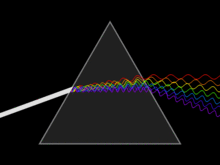
How much light can fit down this tube of light which is the frequency of one wavelength of light?  That is a question you will have to answer yourself. Keep hunting until you have an answer which satisfies you.
Does ligh travel in two directions to create the wavelength of light? No, we don;t think so, but maybe we can demonstrate that two beans can travel in opposite directions (between two mirrors) without interfering with each other.
How much light will do this before it causes interferrence? This is the technology calles lasers, and one of the problems with lasers is that they cause heat to build up, so pure light can produce heat, but this is also cause when the intense light excites (transfers energy to) the molecules of air through which it is passing.

 A sphere has 2/3 the volume and surface area of its circumscribing cylinder. A sphere and cylinder were placed on the tomb of Archimedes at his request.

White light is just a mixture of all the colours of the rainbow, just as whithe noise is a mixture of all (many) frequencies of sound.

but


gravity doesn't affect light atoms like Hydrogen and Helium and Oxygen as much as it does heavier elements like iron and gold, and molecules like water which is made of hydrogen and oxygen.

 Frequency is the number of occurrences of a repeating event per unit time. It is also referred to as temporal frequency. The period is the duration of one cycle in a repeating event, so the period is the reciprocal of the frequency. For example, if a newborn baby's heart beats at a frequency of 120 times a minute, its period (the interval between beats) is half a second.

For periodic waves, frequency has an inverse relationship to the concept of wavelength; simply, frequency is inversely proportional to wavelength λ (lambda). The frequency f is equal to the phase velocity v of the wave divided by the wavelength λ of the wave:


f = \frac{v}{\lambda}.

In the special case of electromagnetic waves moving through a vacuum, then v = c, where c is the speed of light in a vacuum, and this expression becomes:


f = \frac{c}{\lambda}.

When waves from a monochrome source travel from one medium to another, their frequency remains exactly the same — only their wavelength and speed change.
 All light travels at the speed of light 'c' where: -
c = λ x f
With 'f' as the frequency of the light.

Einstein showed that light may also be modelled as small quanta or photons of energy 'E' given by: -
E = hf
Where 'h' is Planck's constant.

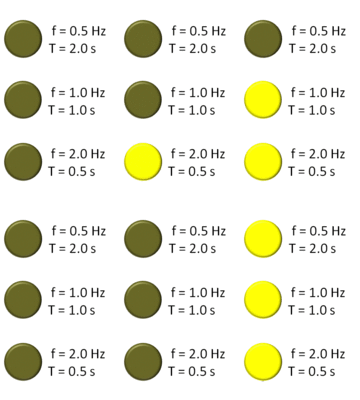
 Three cyclically flashing lights, from lowest frequency (top) to highest frequency (bottom). f is the frequency in hertz (Hz), meaning the number of cycles per second. T is the period in seconds (s), meaning the number of seconds per cycle. T and f are reciprocals.

 Angular frequency ω is defined as the rate of change of angular displacement (during rotation), or in the phase of a sinusoidal waveform (e.g. in oscillations and waves):

\omega=2\pi f.\,
In other words,
\sin(\omega t)=\sin(2\pi f t).\,
Angular frequency is measured in radians per second (rad/s).
  • Spatial frequency is analogous to temporal frequency, but the time axis is replaced by one or more spatial displacement axes.
  • Wavenumber is the spatial analogue of angular frequency. In case of more than one spatial dimension, wavenumber is a vector quantity


Values of h Units
6.62606957(29)×10−34 J·s[1]
4.135667516(91)×10−15 eV·s[1]
6.62606957(29)×10−27 erg·s[1]
Values of ħ Units
1.054571726(47)×10−34 J·s[1]
6.58211928(15)×10−16 eV·s[1]
1.054571726(47)×10−27 erg·s[1]


The Planck constant (denoted h), also called Planck's constant, is a physical constant reflecting the sizes of energy quanta in quantum mechanics. It is named after Max Planck, one of the founders of quantum theory, who discovered it in 1900. Classical statistical mechanics requires the existence of h (but does not define its value).[2]

The Planck constant was first described as the proportionality constant between the energy (E) of a photon and the frequency of its associated electromagnetic wave (ν). This relation between the energy and frequency is called the Planck relation or the Planck–Einstein equation:

E = h\nu.\,

Since the frequency ν, wavelength λ, and speed of light c are related by λν = c, the Planck relation can also be expressed as

E = \frac{hc}{\lambda}.\,

In 1923, Louis de Broglie generalized this relation by postulating that the Planck constant represents the proportionality between the momentum and the quantum wavelength of not just the photon, but any particle. This was confirmed by experiments soon afterwards.


Make a free website with Yola