We can begin with light, and by making a few assumptions about photons, come up with units for cubic capacity, and weight. Ideally we need to know the relationship between a photon and an electron, but we are assuming that if a mass (an atom) is bigger, that the electron may also be bigger. On the other hand, if the weight (size) of an electron is wholly dependant upon the mass of a proton,, and all protons have the same mass, then all electrons will be equal also.
Archemedes told us that the relationship between a sphere and a cylinder of the same radius (or diameter) is that the volume (space taken) of a cylinder will be one third bigger than the volume of the sphere.
What does this mean to us? If light has a wavelength, then that is its width. We know, when making silicon chips for computers by exposing chemicals to light, to make 'printed circuits' that we cannot make the lines of conductors narrower than one wavelength. Even if we filter the light, and use only the narrowest frequency, we cannot go smaller. We can therefore work out the volume of a beam of light, by assuming that a photon is spherical. If it is not flat, it is three dimensional, and if that is so it is spherical, whether or not it has something inside it. We know some things are spherical, but hollow, but others, like atoms, are spherical but have a nucleus.
Three photons in a row, in a beam, travelling through space at the speed of light will take the same volume as the spherical volume of four spheres with the diameter of the frequency of the wavelength of that light.


The closer a photon comes to a mass like the sun, the more it becomes blue shifted.
In physics (especially astrophysics), redshift happens when light seen coming from an object is proportionally increased in wavelength, or shifted to the red end of the spectrum. More generally, where an observer detects electromagnetic radiation outside the visible spectrum, "redder" amounts to a technical shorthand for "increase in electromagnetic wavelength" — which also implies lower frequency and photon energy in accord with, respectively, the wave and quantum theories of light.
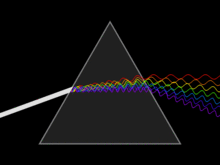
Dispersion causes separation of colors when light is refracted by a prism.
What does this mean? Not a lot, we are just trying to show that while light is considered to be both a wave, and an object with mass, sound needs a medium through which to propogate- travel, like air or water), but light can travel through space. Is that enough to say that to travel through space, something must have mass? To me it is, and that must therefore include all waves which travel in space, like xrays, gamma rays and radio waves, and even magnetic waves, unless it can be shown that magnetic forces do not work in space, and it has not been. But does it extend to gravity?
To me gravity is momentum, angulat momentum if you like, but basically it is an inert force consisting of mass and velocity.
You will have noticed that I have not yet explained why object fall down because of gravity, but gravity doesn't affect light atoms like Hydrogen and Helium and Oxygen as much as it does heavier elements like iron and gold, and molecules like water which is made of hydrogen and oxygen.
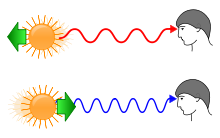
Redshift and blueshift. An object (light source) moving away looks red shifted.
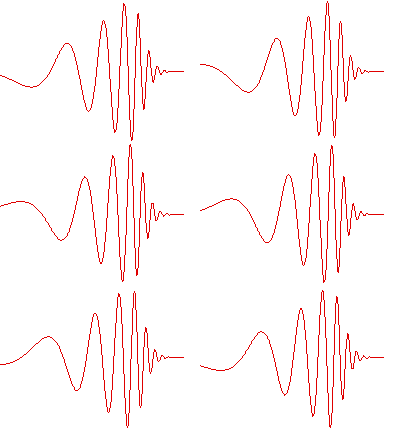
A sinusoidal wave in a nonuniform medium, with loss. As the wave slows down, the wavelength gets shorter and the amplitude increases; after a place of maximum response, the short wavelength is associated with a high loss and the wave dies out.
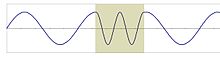
Wavelength is decreased in a medium with higher refractive index.
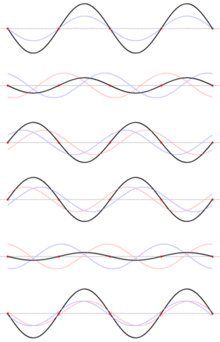
A standing wave (black) depicted as the sum of two propagating waves traveling in opposite directions (red and blue).
All that we have shown here is that light can have different frequencies which the human eye sees as different colours, and we also know that colour can be created for the eye by mixing different colours such as red and yellow to make orange, or blue and yellow to make green and blue and red to make purple. We also think that orange and green and purple are frequencies of light which exist and are pure light of a specific frequency.
Waves have wavelength and height. Wavelength is measured along direction of propogation (of the beam of light), and thus it is the wavelength of light which determines which colour we see.