Albert Einstein described what he thought would happen to clocks to an observer in a moving train, as the train approached the speed of light. He also described what would hapen to a unit of length. It makes sense, that if you are moving away from a clock at the speed of light, the image does not change, and time appears to have stopped. The same can be said when we look at a supernova, such as the one in the Crab Nebulae, which is about 5,000 light years away, and appeared to those on earth about 1,000 years ago. What observers on earth had seen had happened
5,000 years previously, and the light had taken 5,000 years to reach the
earth.
The picture which unfolded in the sky above them was exactly the
same as would have been seen by an observer in the equivalent
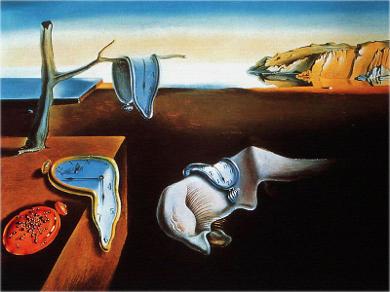
The Persistence of Memory, by Salvidor Dali in which he shows clocks all displaying different times, and bent under their own weight.
in the equivalent space time frame that mars is to our earth, if there had been one in that solar system.
The way I prefer to think of it isas in the example of a man who 700 years ago climbed into a canoe and paddled out into the pacific ocean. Imagine that he eventually came to an island where the people welcomed him and he stayed for about ten years. Then he hopped back in his canoe, and paddled home, but when he got there he fould that everyone he had left behind had aged forty years, and were now nearly 60 years old, while he had aged only ten years and was about thirty. What would have happened if he had gone to another planet, in another galaxy which happened to be travelling proportionately faster that the people in his home island on planet earth, was that while time appeard to be travelling at the same spped to him, compared to the people on earth, time would be slower, so that when he returned, in comparison, people on earth would have lived four times as long.
You may be interested to calculate how fast we on earth are travelling as a proportion of the speed of light, and at what speed (or propotion of the speed of light) people on another planet would have to travel to slow time by 400%. I'm not going to work it out but it is a simple equation. Conversely, Einstein's General Relativity also states that a measurement on the speeding planet would be four times as long- or appear four times as long -to an observer on earth if they could see it, but to a person on that planet, it would appear normal. Do you agree, that if time is four times shorter, length is proportionately four times longer? The important thing to remember is, teh faster you go, the more time slows, relative to tehoriginal starting point.