Origin: joint programme by Italy and Brazil, first flight 1983.
Type: Single seat attack.
Engine: One 11,030lb (5,003kg) thrust Rolls Royce Spey 807 turbofan produced under licence by Alpha Romeo and Piaggio.
Future: Though there will cintinue to be minor differences between the Italian and (initial buy expected to be 187) and Brazilian (about 80) aircraft, due to different mission requirements and NATO refusal to grant export licences for certain items such as the M61 gun, the commonality betwen the aircraft for the two air forces is about 97 per cent and this is unlikely to fall significantly. Space has been left for such items as an attack radar, which is needed for effective anti-ship missions, and for NIS, JTIDS, GPNS and similar disirable add-ons.
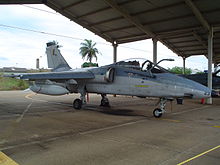
AMX Brazilian Air Force.
 Brazil
ian Air Force operates 55 AMXs.[6]
Brazil
Brazilian Air Force operates 55 AMXs.[6]
 Italy
Italian Air Force operates 43× AMX ACOL and 12× AMX-T ACOL (out of four prototypes, 110 one-seaters and 26 two-seaters delivered)
Italy
Italian Air Force operates 43× AMX ACOL and 12× AMX-T ACOL (out of four prototypes, 110 one-seaters and 26 two-seaters delivered)
The Rolls-Royce Spey (company designations RB.163 and RB.168 and RB183) is a low-bypass turbofan engine originally designed and manufactured by Rolls-Royce that has been in widespread service for over 40 years. Intended for the civilian jet airliner market when it was being designed in the late 1950s, the Spey concept was also used in various military engines, and later as a turboshaft engine for ships known as the Marine Spey, and even as the basis for a new civilian line, the Rolls-Royce Tay. A licensed version built by the XAEC is known as the WS-9 Qin Ling. Aviation versions of the "base model" have accumulated over 50 million hours of flight time. In keeping with Rolls-Royce naming practices, the engine is named after the River Spey.
The latest of the Spey family is the Spey 807, a two shaft turbofan with a four-stage low pressure (LP) and 12-stage high pressure (HP) compressor driven by a two-stage LP and two-stage HP turbine respectively. The combustor is of cannular design with 10 liners, as all other Spey variants.
The Spey 807 for the single-engined AMX strike aircraft is in service in Italy and Brazil. Other Spey variants such as the Spey 250 power the BAE SYSTEMS Nimrod MR2patrol aircraft. In addition, the Spey powers the military versions of Gulfstream GII and GIII aircraft in service in VIP transport and reconnaissance roles with a number of armed forces around the world.