Surface area of a sphere
The surface area of a sphere is given by the following formula

This formula was first derived by Archimedes, based upon the fact that the projection to the lateral surface of a circumscribing cylinder (i.e. the Lambert cylindrical equal-area projection) is area-preserving. It is also the derivative of the formula for the volume with respect to r because the total volume of a sphere of radius r can be thought of as the summation of the surface area of an infinite number of spherical shells of infinitesimal thickness concentrically stacked inside one another from radius 0 to radius r. At infinitesimal thickness the discrepancy between the inner and outer surface area of any given shell is infinitesimal and the elemental volume at radius r is simply the product of the surface area at radius r and the infinitesimal thickness.
At any given radius r, the incremental volume (δV) is given by the product of the surface area at radius r (A(r)) and the thickness of a shell (δr):

The total volume is the summation of all shell volumes:

In the limit as δr approaches zero[1] this becomes:

Since we have already proved what the volume is, we can substitute V:
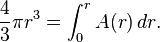
Differentiating both sides of this equation with respect to r yields A as a function of r:
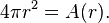
Which is generally abbreviated as:
Alternatively, the area element on the sphere is given in spherical coordinates by  . With Cartesian coordinates, the area element
  . More generally, see area element.
The total area can thus be obtained by integration:

Equations in R3
In analytic geometry, a sphere with center (x0, y0, z0) and radius r is the locus of all points (x, y, z) such that

The points on the sphere with radius r can be parametrized via


(see also trigonometric functions and spherical coordinates).
A sphere of any radius centered at zero is an integral surface of the following differential form:

This equation reflects the fact that the position and velocity vectors of a point travelling on the sphere are always orthogonal to each other.
The sphere has the smallest surface area among all surfaces enclosing a given volume and it encloses the largest volume among all closed surfaces with a given surface area. For this reason, the sphere appears in nature: for instance bubbles and small water drops are roughly spherical, because the surface tension locally minimizes surface area. The surface area in relation to the mass of a sphere is called the specific surface area. From the above stated equations it can be expressed as follows:
