We know how an iceberg shows only a small percentage (about 1/9th) of its volume above water. This is because ice has a structure which makes it lighter than water, so it floats on the surface. Despite this, it has weight, (mass) so it displaces water and sinks down until the (weight of the) water it displaces is equal to the weight of the ice. The same is true of atoms. They have a physical structure which at the same time forces other matter away, and constrains the physical boundary which defines them.
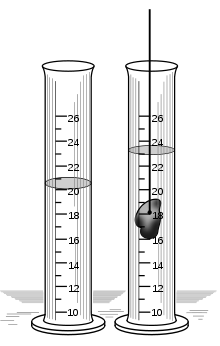
Two graduated cylinders containing water, one with a rock submerged in it, showing the increased water level due to displacement
Angular displacement.
Angular displacement of a body is the angle in radians (degrees, revolutions) through which a point or line has been rotated in a specified sense about a specified axis.
When an object rotates about its axis, the motion cannot simply be analyzed as a particle, since in circular motion it undergoes a changing velocity and acceleration at any time (t). When dealing with the rotation of an object, it becomes simpler to consider the body itself rigid. A body is generally considered rigid when the separations between all the particles remains constant throughout the objects motion, so for example parts of its mass are not flying off. In a realistic sense, all things can be deformable, however this impact is minimal and negligible. Thus t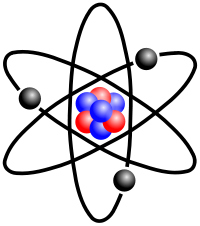
Rotation of a rigid object P about a fixed object about a fixed axis O.
The word displacement refers to the weight of the water that the ship displaces while floating.[3] Another way of thinking about displacement is the amount of water that would spill out of a completely filled container were the ship to be placed into it. A floating ship always displaces an amount of water of the same weight as the ship.[3]
The density (weight per unit of volume) of water can vary. For example, the average density of seawater at the surface of the ocean is 1025 kg/m³ (10.25 lb/ga, 8.55 lb/US gallon), fresh water on the other hand has a density of about 1000 kg/m³ (10.00 lb/ga, 8.35 lb/US gallon).[2] Consider a 100-ton ship passing from a saltwater sea into a freshwater river. It always displaces exactly 100 tons of water, but it has to displace a greater volume of fresh water to amount to 100 tons. Therefore it would sit slightly lower in the water in the freshwater river than it would in the saltwater sea.
Gluons
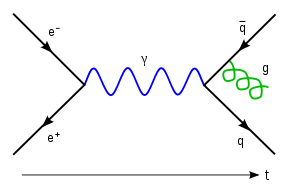
Gluons ( /ˈɡluːɒnz/; from English glue) are elementary particles which act as the exchange particles (or gauge bosons) for the color force between quarks, analogous to the exchange of photons in the electromagnetic force between two charged particles.[6]
In particle physics, color charge is a property of quarks and gluons that is related to the particles' strong interactions in the theory of quantum chromodynamics (QCD). Color charge has analogies with the notion of electric charge of particles, but because of the mathematical complications of QCD, there are many technical differences.
Feynman diagrams are a pictorial representation scheme for the mathematical expressions governing the behavior of subatomic particles, first developed by the Nobel Prize-winning American physicist Richard Feynman, and first introduced in 1948. The interaction of sub-atomic particles can be complex and difficult to understand intuitively, and the Feynman diagrams allow for a simple visualization of what would otherwise be a rather arcane and abstract formula. As David Kaiser writes, "since the middle of the 20th century, theoretical physicists have increasingly turned to this tool to help them undertake critical calculations," and as such "Feynman diagrams have revolutionized nearly every aspect of theoretical physics".[1] While the diagrams are applied primarily to quantum field theory, they can also be used in other fields, such as solid-state theory.

An iceberg is a large piece of ice from freshwater that has broken off from a snow-formed glacier or ice shelf and is floating in open water.[1][2
Because the density of pure ice is about 920 kg/m³, and that of sea water about 1025 kg/m³, typically only one-ninth of the volume of an iceberg is above water. The shape of the underwater portion can be difficult to judge by looking at the portion above the surface. This has led to the expression "tip of the iceberg", for a problem or difficulty that is only a small manifestation of a larger problem.
The electron
The electron (symbol: e−
) is a subatomic particle with a negative elementary electric charge. It has no known components or substructure; in other words, it is generally thought to be an elementary particle.[2]
An electron has a mass that is approximately 1/1836 that of the proton.[8]
Older literature distinguished between X- and gamma radiation on the basis of wavelength, with radiation shorter than some arbitrary wavelength, such as 10−11 m, defined as gamma rays.[6] However, as shorter wavelength continuous spectrum "X-ray" sources such as linear accelerators and longer wavelength "gamma ray" emitters were discovered, the wavelength bands largely overlapped. The two types of radiation are now usually distinguished by their origin: X-rays are emitted by electrons outside the nucleus, while gamma rays are emitted by the nucleus.[5][7][8][9]
As electromagnetic radiation, X-rays follow the following laws:
- as a wave, the wavelength
 where f is the frequency of the radiation and v is its phase velocity (in a vacuum, c, the speed of light, 3×10⁸ metres per second);
 - as a particle, the energy of a photon is E = hf, where f is the frequency and h is Planck's constant, 4.1356×10⁻¹⁵ in units of electron-volt · seconds; combined,
 ;
;
In 1947 Willis Lamb, working in collaboration with graduate student Robert Rutherford, found that certain quantum states of hydrogen atom, which should have the same energy, were shifted in relation to each other, the difference being the Lamb shift. About the same time, Polykarp Kusch, working with Henry M. Foley, discovered the magnetic moment of the electron is slightly larger than predicted by Dirac's theory. This small difference was later called anomalous magnetic dipole moment of the electron. To resolve these issues, a refined theory called quantum electrodynamics was developed by Sin-Itiro Tomonaga, Julian Schwinger and Richard P. Feynman in the late 1940s.[57]
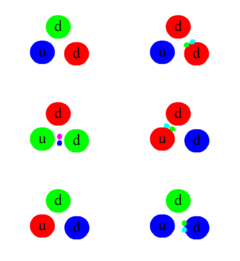
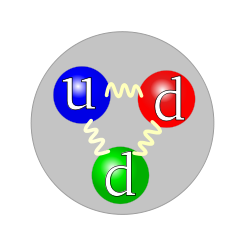
An animation of the interaction inside a neutron
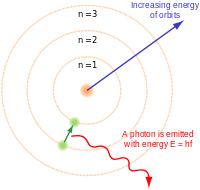
The experiment shows that a single photon can be emitted from an atom when increased energy causes a change in state. It is assumed that this comes from an electron, and we know that there are energy levels for electrons associated with protons in the nucleus. This results in the formula E=hf, but it doesn't explain what is going on. We know, for example that two electrons fit into the first shell, and up to eight fit into the second shell. The third level (or shell) also contains up to eight. This is because the energy of the nucleus of the proton (or groups of protons), because of the inverse square law, has sufficient force to stop more than this number from attaching themselves, while also having enough energy to hold this number in. Can this be done using only a revolving (in three dimensions) repulsive force like a charge? The inverse square law says that when you double the distance (go to the next level) you must square the force (in the centre). This means that between the second and third level (10 protons and 11 and up to 18, something structurally different is happening in the nucleus of the atom.
What the experiment doesn't tell us is whether when a photon is emitted, something attached to it, keeping it in orbit, falls back into the atom (electron) and what the quantity and relationship of this group of unnamed matter is.
We cannot assume that an electron in an atom rotates about one fixed axis (central point) because it is possible that momentum (energy) is being transferred between electrons within and around the nucleus, causing some to travel faster, and some slower at times. In general, an electron travelling twice as fast will have twice the energy as one travelling half as fast, but may have to lose mass to do so. One photon would appear to be a very small amount of energy compared to the energy of an electron. Does an electron have the same energy as a proton, when they are in balance? With the mass of the electron being 1/1836th of the proton, that does not seem possible. How then, do we explain the relationship between the two?

Argon, an 'inert' gas with 18 protons, and 18 electrons, 8 in the outermost shell.
What the experiment doesn't tell us is whether when a photon is emitted, something attached to it, keeping it in orbit, falls back into the atom (electron) and what the quantity and relationship of this group of unnamed matter is.
We cannot assume that an electron in an atom rotates about one fixed axis (central point) because it is possible that momentum (energy) is being transferred between electrons within and around the nucleus, causing some to travel faster, and some slower at times. In general, an electron travelling twice as fast will have twice the energy as one travelling half as fast, but may have to lose mass to do so. One photon would appear to be a very small amount of energy compared to the energy of an electron. Does an electron have the same energy as a proton, when they are in balance? With the mass of the electron being 1/1836th of the proton, that does not seem possible. How then, do we explain the relationship between the two?
One-loop MSSM corrections to the muon g-2 involving a neutralino and a smuon, and a chargino and a muon sneutrino respectively.
In particle physics, the chargino is a hypothetical particle which refers to the mass eigenstates of a charged superpartner, i.e. any new electrically charged fermion (with spin 1/2) predicted by supersymmetry. They are linear combinations of the charged wino and charged higgsinos. There are two charginos that are fermions and are electrically charged, which are typically labeled C͂±
1 (the lightest) and C͂±
2 (the heaviest) although sometimes  and
and  is also used to refer to charginos, when
  is used to refer to neutralinos.
The heavier chargino can decay through the neutral Z boson to the
lighter chargino. Both can decay through a charged W boson to a
neutralino:
is used to refer to neutralinos.
The heavier chargino can decay through the neutral Z boson to the
lighter chargino. Both can decay through a charged W boson to a
neutralino:
- C͂±
2 → C͂±
1 + Z0 - C͂±
2 → N͂0
2 + W± - C͂±
1 → N͂0
1 + W±