On this page we are still investigating the motion of the protons and neutrons within the nucleus of the atom, and the 'rotation' of the electron(s) around it, and also the spin of the photons and electrons and other quantum particles themselves, but we are using analogy, and the motions of the planets around the sun to determine some of the possibilities.
Let us suppose that we could flip the earth (or a planet) upside down. Which way would we flip it?
Lets say the north pole was swapped for the south pole, would it make any difference?
Lets say we could swap another planet over. If we went to that planet (and there is one, remarkably enough, in our solar system) and say we manufactured something, such as a plane of glass, or a mirror. Is it possible that when we brought it back to earth that it would have the opposite spin on its atoms? Not so you say, but you won't know until we try it. How would it therefore be possible to make a pane of glass or a mirror such that when placed next to a pane of glass or a mirror manufactured on earth, the reflection of something (a truck driving along a road) made it appear that two trucks (the same reflection) were driving toward each other. What if I said I own such a mirror, how would you explain it?
Rotational speed (sometimes called speed of revolution) tells how many complete rotations (i.e. revolutions or cycles) there are per time unit. It is therefore a cyclic frequency, measured in hertz (revolutions per second) in the SI System. The units revolutions per minute (rpm or 1/min) are more common in everyday life.
Rotational speed is not to be confused with tangential speed, despite some relation between the two concepts. Imagine a rotating merry-go-round. No matter how close or far you stand from the axis of rotation, your rotational speed will remain constant. However, your tangential speed does not remain constant. If you stand two meters from the axis of rotation, your tangential speed will be double the amount if you were standing only one meter from the axis of rotation.
Rotation
A rotation is a circular movement of an object around a center (or point) of rotation. A three-dimensional object rotates always around an imaginary line called a rotation axis. If the axis is within the body, and passes through its center of mass the body is said to rotate upon itself, or spin. A rotation about an external point, e.g. the Earth about the Sun, is called a revolution or orbital revolution, typically when it is produced by gravity.
Main article: Retrograde motion
Most planets in our solar system, including Earth, spin in the same direction as they orbit the Sun. The exceptions are Venus and Uranus. Uranus rotates nearly on its side relative to its orbit. Current speculation is that Uranus started off with a typical prograde orientation and was knocked on its side by a large impact early in its history. Venus may be thought of as rotating slowly backwards (or being "upside down"). The dwarf planet Pluto (formerly considered a planet) is anomalous in this and other ways.
Something else to consider is: Does an atom act like an electric motor as electrons spin and rotate their way around them. We know that electric currents generate electric and magnetic fields, but how exactly do they manifest themselves in the structures of atoms? One element in particular, Iron, can me 'magnetised, and will hold a magnetic field, with a north pole at one end and a south or negative magnetic charge at the other. This can be created by rubbing in one direction, or applying a magnetic or electric field to one end. This can also be reversed by applying a stronger field to the other end, and remains. Why is it that iron has an atomic structure which enables it to do this, while other atoms do not do it? Likewise, Silver is a very good reflector of light. We suppose that this is so because all the atoms in silver are a similar size (protons and neutrons are densly packed?). Why is this not therefore true of other atoms to the same extent?
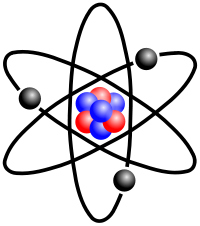
A polyhedron resembling a sphere rotating around an axis.
Pluto's rotation period, its day, is equal to 6.39 Earth days.[64] Like Uranus, Pluto rotates on its "side" on its orbital plane, with an axial tilt of 120°, and so its seasonal variation is extreme; at its solstices, one-fourth of its surface is in permanent daylight, while another fourth is in permanent darkness.[65]