Why do like charges repel each other, and opposite charges attract?
To understand it, you don't need the real explanation, you just need an idea in you head to help you understand why it may be so.
Unlike charges attract:
We know that the moon orbits the earth, and we think the explanation is gravity. We know that an object will continue on its path until it is subject to a force. This is especially noticeable in space, where we have seen images of objects floating away, and bouncing off solid objects.
The moon orbits the earth, but it rotates to show only one side to the earth. That is, it makes one rotation every time it orbits the earth once, and we never see the "dark side" of the moon.
Why is this so, and is it like unlike charges attracting? Imagine an egg or other irregularly shaped object, (like a rock) tumbling down a ramp, or an object floating in some water (the ocean). Why does the heavy side end up facing down? We think the moon had a liquid core at some time in the past, but it solidified, and one side of the moon is now 'heavier' than the other, and so continues to 'face' the earth as the moon orbits.
Here is the problem. F=MA
n,
The Moon has an external magnetic field of the order of one to a hundred nanoteslas, less than one-hundredth that of the Earth. It does not currently have a global dipolar magnetic field, as would be generated by a liquid metal core geodynamo, and only has crustal magnetization, probably acquired early in lunar history when a geodynamo was still operating.[69][70] Alternatively, some of the remnant magnetization may be from transient magnetic fields generated during large impact events, through the expansion of an impact-generated plasma cloud in the presence of an ambient magnetic field—this is supported by the apparent location of the largest crustal magnetizations near the antipodes of the giant impact basins.[71]
Here is the problem. F=MA
Inertia
Inertia is the resistance of any physical object to a change in its state of motion or rest, or the tendency of an object to resist any change in its motion. It is proportional to an object's mass. The principle of inertia is one of the fundamental principles of classical physics which are used to describe the motion of matter and how it is affected by applied forces. Inertia comes from the Latin word, iners, meaning idle, or lazy. Isaac Newton defined inertia as his first law in his Philosophiæ Naturalis Principia Mathematica, which states:[1]
The vis insita, or innate force of matter, is a power of resisting by which every body, as much as in it lies, endeavours to preserve its present state, whether it be of rest or of moving uniformly forward in a straight line.
Relativity
Albert Einstein's theory of Special Relativity, as proposed in his 1905 paper, "On the Electrodynamics of Moving Bodies," was built on the understanding of inertia and inertial reference frames developed by Galileo and Newton. While this revolutionary theory did significantly change the meaning of many Newtonian concepts such as mass, energy, and distance, Einstein's concept of inertia remained unchanged from Newton's original meaning (in fact the entire theory was based on Newton's definition of inertia). However, this resulted in a limitation inherent in Special Relativity that the principle of relativity could only apply to reference frames that were inertial in nature (meaning when no acceleration was present). In an attempt to address this limitation, Einstein proceeded to develop his General Theory of Relativity ("The Foundation of the General Theory of Relativity," 1916), which ultimately provided a unified theory for both inertial and noninertial (accelerated) reference frames. However, in order to accomplish this, in General Relativity Einstein found it necessary to redefine several fundamental concepts (such as gravity) in terms of a new concept of "curvature" of space-time, instead of the more traditional system of forces understood by Newton.
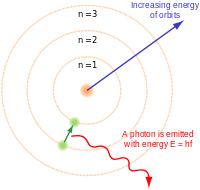
The Rutherford–Bohr model of the hydrogen atom (Z = 1) or a hydrogen-like ion (Z > 1), where the negatively charged electron confined to an atomic shell encircles a small, positively charged atomic nucleus and where an electron jump between orbits is accompanied by an emitted or absorbed amount of electromagnetic energy (hν).[1] The orbits in which the electron may travel are shown as grey circles; their radius increases as n2, where n is the principal quantum number. The 3 → 2 transition depicted here produces the first line of the Balmer series, and for hydrogen (Z = 1) it results in a photon of wavelength 656 nm (red light
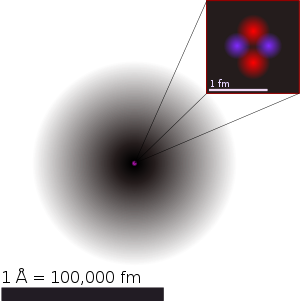
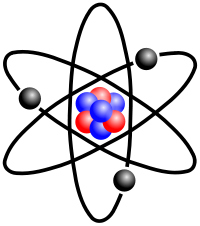
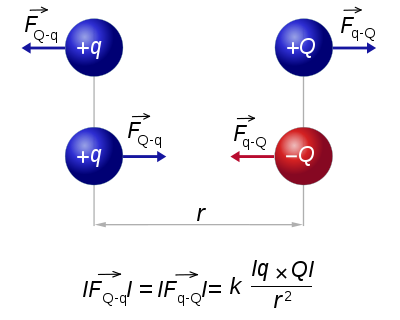
Diagram describing the basic mechanism of Coulomb's law; like charges repel each other and opposite charges attract each other.
As a result of this redefinition, Einstein also redefined the concept of "inertia" in terms of geodesic deviation instead, with some subtle but significant additional implications. The result of this is that according to General Relativity, when dealing with very large scales, the traditional Newtonian idea of "inertia" does not actually apply, and cannot necessarily be relied upon. Luckily, for sufficiently small regions of spacetime, the Special Theory can still be used, in which inertia still means the same (and works the same) as in the classical model.
Another profound, perhaps the most well-known, conclusion of the theory of Special Relativity was that energy and mass are not separate things, but are, in fact, interchangeable. This new relationship, however, also carried with it new implications for the concept of inertia. The logical conclusion of Special Relativity was that if mass exhibits the principle of inertia, then inertia must also apply to energy as well. This theory, and subsequent experiments confirming some of its conclusions, have also served to radically expand the definition of inertia in some contexts to apply to a much wider context including energy as well as matter.
Mass and inertia
Physics and mathematics appear to be less inclined to use the original concept of inertia as "a tendency to maintain momentum" and instead favor the mathematically useful definition of inertia as the measure of a body's resistance to changes in momentum or simply a body's inertial mass.
This was clear in the beginning of the 20th century, when the theory of relativity was not yet created. Mass, m, denoted something like amount of substance or quantity of matter. And at the same time mass was the quantitative measure of inertia of a body.
The mass of a body determines the momentum p of the body at given velocity v; it is a proportionality factor in the formula:
- p = mv
The factor m is referred to as inertial mass.
But mass as related to 'inertia' of a body can be defined also by the formula:
- F = ma
Here, F is force, m is mass, and a is acceleration.
By this formula, the greater its mass, the less a body accelerates under given force. Masses m defined by formula (1) and (2) are equal because formula (2) is a consequence of formula (1) if mass does not depend on time and velocity. Thus, "mass is the quantitative or numerical measure of body’s inertia, that is of its resistance to being accelerated".
This meaning of a body's inertia therefore is altered from the original meaning as "a tendency to maintain momentum" to a description of the measure of how difficult it is to change the momentum of a body.