There is so much clutter in our theories it is hard to "think". Believe in Fermions, Bosons, Gluons, up, down, charm quarks, etc. if you want, but how does it fit into a different reality, one where the internal mass (charge- energy) of a proton is at least equal to the mass of the proton we can see from the outside? How much space do you really think there is inside a proton for a photon travelling at the speed of light? Is it, for instance, the same space that a photon travelling from the sun to the earth has (taking something over eight minutes), or is all that space taken up with solid matter? How do thos 16 names on the chart in diag. 41 fit in with known sub-atomic structures? If they don't fit naturally into the natural world, they are not worth the billions of research dollars and high salaries paid to "discover" them. It may well have been better to spend all that time and money on a sheet of paper and a pencil. Truth will out. Do you think I will get a nobel prize when this work is finished? Would Jesus get a Nobel Peace Prize if He came back? Not likely, there is too much politics here. It is not about science.
By definition, bosons are particles which obey Bose–Einstein statistics: when one swaps two bosons, the wavefunction of the system is unchanged.[3] Fermions, on the other hand, obey Fermi–Dirac statistics and the Pauli exclusion principle: two fermions cannot occupy the same quantum state, resulting in a "rigidity" or "stiffness" of matter which includes fermions. Thus fermions are sometimes said to be the constituents of matter, while bosons are said to be the particles that transmit interactions (force carriers), or the constituents of radiation. The quantum fields of bosons are bosonic fields, obeying canonical commutation relations.
In statistical mechanics, Bose–Einstein statistics (or more colloquially B–E statistics) determines the statistical distribution of identical indistinguishable bosons over the energy states in thermal equilibrium.
Fermi–Dirac and Bose–Einstein statistics apply when quantum effects are important and the particles are "indistinguishable". Quantum effects appear if the concentration of particles satisfies N/V ≥ nq. Here nq is the quantum concentration, for which the interparticle distance is equal to the thermal de Broglie wavelength, so that the wavefunctions of the particles are touching but not overlapping. Fermi–Dirac statistics apply to fermions (particles that obey the Pauli exclusion principle), and Bose–Einstein statistics apply to bosons. As the quantum concentration depends on temperature; most systems at high temperatures obey the classical (Maxwell–Boltzmann) limit unless they have a very high density, as for a white dwarf. Both Fermi–Dirac and Bose–Einstein become Maxwell–Boltzmann statistics at high temperature or at low concentration.
"Fermion"
In particle physics, a fermion (named after Enrico Fermi) is any particle which obeys the Fermi–Dirac statistics (and follows the Pauli exclusion principle). Fermions contrast with bosons which obey Bose–Einstein statistics.
A fermion can be an elementary particle, such as the electron; or it can be a composite particle, such as the proton. The spin-statistics theorem holds that, in any reasonable relativistic quantum field theory, particles with integer spin are bosons, while particles with half-integer spin are fermions.
In contrast to bosons, only one fermion can occupy a particular quantum state at any given time. If more than one fermion occupies the same physical space, at least one property of each fermion, such as its spin, must be different. Fermions are usually associated with matter, whereas bosons are generally force carrier particles; although in the current state of quantum physics the distinction between the two concepts is unclear.
The Standard Model recognizes two types of elementary fermions: quarks and leptons. In all, the model distinguishes 24 different fermions: 6 quarks and 6 leptons, each with a corresponding anti-particle.
Composite fermions, such as protons and neutrons, are key building blocks of matter. Weakly interacting fermions can also display bosonic behavior under extreme conditions, such as in superconductivity.


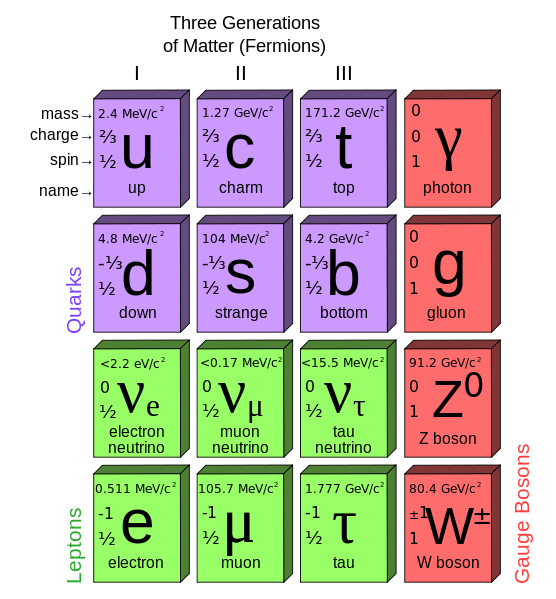
Diag. 41 Three generations of matter.
"Boson"
In particle physics, bosons are subatomic particles that obey Bose–Einstein statistics. Several bosons can occupy the same quantum state. The word boson derives from the name of the Indian physicist Satyendra Nath Bose.[1]
Bosons contrast with fermions, which obey Fermi–Dirac statistics. Two or more fermions cannot occupy the same quantum state.
Since bosons with the same energy can occupy the same place in space, bosons are often force carrier particles. In contrast, fermions are usually associated with matter (although in quantum physics the distinction between the two concepts is not clear cut).
Bosons may be either elementary, like photons, or composite, like mesons. Some composite bosons do not satisfy the criteria for Bose-Einstein statistics and are not truly bosons (e.g. helium-4 atoms); a more accurate term for such composite particles would be "bosonic-composites".
All observed bosons have integer spin, as opposed to fermions, which have half-integer spin. This is in accordance with the spin-statistics theorem which states that in any reasonable relativistic quantum field theory, particles with integer spin are bosons, while particles with half-integer spin are fermions.
While most bosons are composite particles, in the Standard Model, there are six bosons which are elementary:
- the four gauge bosons (γ · g · W±
· Z) - the Higgs boson (H0
) - the Graviton (G)
Unlike the gauge bosons, the Higgs boson and Graviton have not yet been observed experimentally.[2]
Composite bosons are important in superfluidity and other applications of Bose–Einstein condensates.