If momentum is conserved in three dimensional space, is it not also likely to be conserved in four dimensional space?
String theory is an attempt to mathematically reconcile more than three dimensions, but the problemis it ends up with 26 dimensions, one of which is time. Of course we know that space is infinite, so 26 dimensionsis not surprising, but it defies human comprehension. We still have to forget about time as being a physical force.
One way yo deal with it is to forget all about Bosons, Quarks and all the things which complicate the model, and concentrate of what we know for certain.
My initial approach to the problem (of the unified field which Einstein didn't crack), was to look for common factors in the standard atomic weights of the known elements; eg. Hydrogen, 1.00794(7); Helium, 4.002602(2); Lithium, 6.941(2); Beryllium, 9.012182(3); Boron, 10.811(7) and so on. What puzzled me to begin with is why something like Helium didn't just split into two neat halves.
Looking for prime numbers in the atomic weights, it soon became clear that this was not the solution. There were no common factors. How could something made  up of only protons and neutrons have such different atomic weights?

It was time to go back to momentum.

 In mathematics, four-dimensional space ("4D") is an abstract concept derived by generalizing the rules of three-dimensional space. It has been studied by mathematicians and philosophers for almost three hundred years, both for its own interest and for the insights it offered into mathematics and related fields.

Notice how this is only possible if the lenghts of the sides of the shapes vary.


String theory is an active research framework in particle physics that attempts to reconcile quantum mechanics and general relativity.[1] It is a contender for a theory of everything (TOE), a manner of describing the known fundamental forces and matter in a mathematically complete system. The theory has yet to make novel experimental predictions at accessible energy scales, leading some scientists to claim that it cannot be considered a part of science.[2]

String theory posits mainly that the electrons and quarks within an atom are not 0-dimensional objects, but rather 1-dimensional oscillating lines ("strings"). The earliest string model, the bosonic string, incorporated only bosons, although this view developed to the superstring theory, which posits that a connection (a "supersymmetry") exists between bosons and fermions. String theories also require the existence of several extra, unobservable dimensions to the universe, in addition to the four known spacetime dimensions.

 The linear momentum of a system of particles can also be defined as the product of the total mass, m, of the system times the velocity, vcm, of the center of mass.

\sum{\mathbf{F}} = {d\mathbf{p} \over dt}= m \frac{d\mathbf{v}_{cm}}{dt}=m\mathbf{a}_{cm}\,

This is a special case of Newton's second law (if mass is constant).

For a more general derivation using tensors, we consider a moving body (see Figure), assumed as a continuum, occupying a volume V, at a time t, having a surface area S, with defined traction or surface forces per unit area represented by the stress vector \scriptstyle T_i^{(n)}\, acting on every point of every body surface (external and internal), body forces Fi per unit of volume on every point within the volume V, and a velocity field vi, prescribed throughout the body.
The other thing which was odd, was that with respect to the inert (noble) gases: Helium, Neon, Argon, Krypton, Xenon, it appeared that contrary to it appearing they (elements in the same row or period)  became heavier as their electron shells filled up, it was as though the atoms were/are on a balance scale supported at one end by a spring, so that as weight is taken off, they level up to being inert. (Don't worry about this explanation as it is quirky and probably meaningless.)


Although bosonic string theory has many attractive features, it falls short as a viable physical model in two significant areas and is forced to posit a 26 dimensional spacetime to remedy inconsistencies.

Firstly, it predicts only the existence of bosons whereas many physical particles are fermions.

Secondly, it predicts the existence of a particle whose mass is imaginary implying that it travels faster than light. The existence of such a particle, commonly known as a tachyon, would conflict with much of what is known about physics and such particles have never been observed.

In addition, bosonic string theory displays inconsistencies due to the conformal anomaly. But, as was first noticed by Claud Lovelace, in a spacetime of 26 dimensions, with 25 dimensions of space and one of time, the inconsistencies cancel. Bosonic string theory predicts unphysical particle states called 'ghosts'. In 26 dimensions, the no-ghost theorem predicts that these ghost states have no interaction whatsoever with any other states and hence they can be ignored leaving a consistent theory. This high dimensionality is not a problem for bosonic string theory because it can be formulated in such a way that along the 22 excess dimensions spacetime is folded up to form a small torus. This would leave only the familiar four dimensions of spacetime visible.

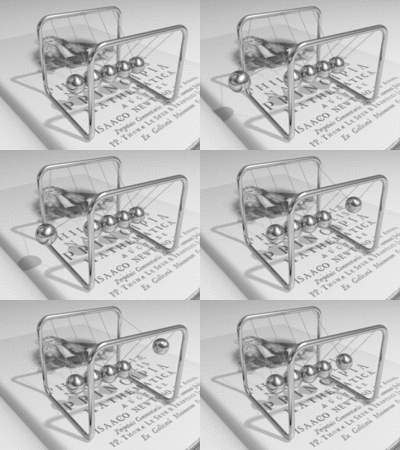
 A Newton's cradle demonstrates conservation of momentum.

 If an object is moving in any reference frame, then it has momentum in that frame. It is important to note that momentum is frame dependent. That is, the same object may have a certain momentum in one frame of reference, but a different amount in another frame. For example, a moving object has momentum in a reference frame fixed to a spot on the ground, while at the same time having 0 momentum in a reference frame attached to the object's center of mass.

The amount of momentum that an object has depends on two physical quantities: the mass and the velocity of the moving object in the frame of reference. In physics, the usual symbol for momentum is a boldface p (bold because it is a vector); so this can be written

\mathbf{p}= m \mathbf{v}\,,

where p is the momentum, m is the mass and v is the velocity.

Example: a model airplane of 1 kg traveling due north at 1 m/s in straight and level flight has a momentum of 1 kg•m/s due north measured from the ground. To the dummy pilot in the cockpit it has a velocity and momentum of zero.

According to Newton's second law, the rate of change of the momentum of a particle is proportional to the resultant force acting on the particle and is in the direction of that force.

Click on the periodic table to open a larger image.

 The properties of the noble gases can be well explained by modern theories of atomic structure: their outer shell of valence electrons is considered to be "full", giving them little tendency to participate in chemical reactions, and it has only been possible to prepare a few hundred noble gas compounds.

 Density

Mathematically, density is defined as mass divided by volume:

 \rho = \frac{m}{V},

where ρ is the density, m is the mass, and V is the volume. From this equation, mass density must have units of a unit of mass per unit of volume. As there are many units of mass and volume covering many different magnitudes there are a large number of units for mass density in use.


Make a free website with Yola