If there is really a fourth dimension, where is it, and what does it look like? One possibility is that it is literally inside the mass of an object.
Does a photon have an inside, or is it flat (two-dimensional), or three dimensional? At present we think a photon is three dimensional, but one reason for its behaviour could be that it is flat. All its energy could be its momentum (its mass which is zero or almost zero) times its velocity which is the speed of light.
The earth and the solar system (the planets and the sun) are moving around the centre of the galaxy at about 220km per second. You could say they (we) are travelling in a giant ellipse. You could also say we are travelling in a straight line, which it more or less is. We are travelling is space, wich is outer space, but space is full of charges particles, electromagnetic energy and the occasional mass (star or sun).
The space inside the atom is similar. Electrons are orbiting the nucleus. Electrons are composed of like charges (all electrons share the same charge) which is determined by the charge of the protn, which has a positive charge. Electrons are then said to be negatively charged, and will flow (like water in a pipe) along a conductor (metal wire) towrds a negatice charge. Why the contradiction- (like charges repel)? It is becaue charges are concentrated at the positive point. They want to balance their energy, just as water will flow down hill or a ball bearing down a channel, due to gravity.
In an atom, an electron 'flows' around and around, due to the same gravity.

Imagine that the two blue spots are two protons, and the black circles are two fields, representing tow electrons. They (the electrons) repel each other.
Now imagine that the point where the two black circles intersect (touch) represents the path of a single electron. However it is following a path represented by the mobius below.

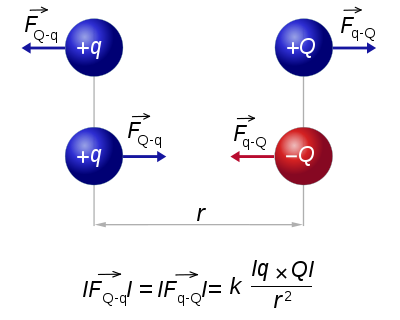
Diagram describing the basic mechanism of Coulomb's law; like charges repel each other and opposite charges attract each other.
The atmosphere of the earth is subject to pressure from the sun in the form of a solar wind. The quantifiable pressure has been debated, and given as approximately 14 lbs per square inch, but is likely to be much more than this.

Ionospheric layers.
What happens, is that the electron (or ant) travels twice the distance before it completes a fill circle (than it does if the edges are joined normally.
What this is describing, is what would happen if once every second revolution of the proton, the electron was 'pushed over', or, its polarity (reference charge) changed from relatively positive to relatively negative. Thhis could happen if something was coming from inside the proton, but returning back inside, in an orbot which was partly inside the nucleus (of the proton) and partly outside it.
In everyday usage, vacuum is a volume of space that is essentially empty of matter, such that its gaseous pressure is much less than atmospheric pressure.[1] The word comes from the Latin term for "empty". Physicists often discuss ideal test results that would occur in a perfect vacuum, which they simply call "vacuum" or "free space", and use the term partial vacuum to refer to an actual imperfect vacuum as one might have in a laboratory or in space. The Latin term in vacuo is also used to describe an object as being in what would otherwise be a vacuum.

Outer space is not a perfect vacuum, but a tenuous plasma awash with charged particles, electromagnetic fields, and the occasional star.

The upper atmosphere is ionized by solar radiation. That means the Sun's energy is so strong at this level, that it breaks apart molecules. So there ends up being electrons floating around and molecules which have lost or gained electrons. When the Sun is active, more and more ionization happens!

This image shows how different types of solar radiation (x-rays to
infrared radiation) penetrate into the Earth's atmosphere. It is this
solar radiation that ionizes the upper atmosphere, creating the
ionosphere.
Click on image for full size
Windows to the Universe original image
Radiation pressure is the pressure exerted upon any surface exposed to electromagnetic radiation. If absorbed, the pressure is the power flux density divided by the speed of light. If the radiation is totally reflected, the radiation pressure is doubled. For example, the radiation of the Sun at the Earth has a power flux density of 1,370 W/m2, so the radiation pressure is 4.6 µPa (absorbed).