www.rainierbank.biz

 Red shift & speed of light

What does the universe look like. It is expanding since the 'Big Bang', but I prefer to believe that it will stop expanding and become a 'solid state universe'. It all depends if you believe in God or not, and if you do, what that means to us. God is like light, it is there, but we don't understand much about it. The difference is, light is a thing, but God is intelligent, very, very intelligent.
How can we see light from a distant galaxy, and how fast can it receed away from us. Presumably, if there was a big bang, then there is another side of it, and we are (both sides) travelling away from each other at the speed of expansion. Red shifted light is not travelling away from us at the speed of light, or we would not see it, it is travelling away fom us as a speed slower than the speed of light because the source it comes from (a galaxy) has a mass larger than a photon. Hubble wrote an equation for red shift, Hubble's Law..
The big bang teaches us how things started, but is there another way to get to somewhere distant, other than travelling through space?

 Expansion of the universe changed

The distance c / H0 is known as the "Hubble length". It is equal to 13.9 billion light years in the standard cosmological model, similar to but somewhat larger than c times the age of the universe. This is because 1 / H0 gives the age of the universe by a backward extrapolation which assumes that the recession speed of each galaxy has been constant since the Big Bang. In fact, recession speeds initially decelerate due to gravity, and are now accelerating due to dark energy, so that 1 / H0 is only an approximation to the true age.


Hawking's principal fields of research are theoretical cosmology and quantum gravity.

In the late 1960s, he and his Cambridge friend and colleague, Roger Penrose, applied a new, complex mathematical model they had created from Albert Einstein's theory of general relativity.[20] This led, in 1970, to Hawking proving the first of many singularity theorems; such theorems provide a set of sufficient conditions for the existence of a gravitational singularity in space-time. This work showed that, far from being mathematical curiosities which appear only in special cases, singularities are a fairly generic feature of general relativity.[21]

He supplied a mathematical proof, along with Brandon Carter, Werner Israel and D. Robinson, of John Wheeler's no-hair theorem – namely, that any black hole is fully described by the three properties of mass, angular momentum, and electric charge.

Hawking also suggested upon analysis of gamma ray emissions that after the Big Bang, primordial mini black holes were formed. With Bardeen and Carter, he proposed the four laws of black hole mechanics, drawing an analogy with thermodynamics. In 1974, he calculated that black holes should thermally create and emit subatomic particles, known today as Bekenstein-Hawking radiation, until they exhaust their energy and evaporate.[22]

In collaboration with Jim Hartle, Hawking developed a model in which the universe had no boundary in space-time, replacing the initial singularity of the classical Big Bang models with a region akin to the North Pole: one cannot travel north of the North Pole, as there is no boundary. While originally the no-boundary proposal predicted a closed universe, discussions with Neil Turok led to the realisation that the no-boundary proposal is also consistent with a universe which is not closed.

 Shape of the universe

Before the advent of modern cosmology, there was considerable talk about the size and shape of the universe. In 1920, the famous Shapley-Curtis debate took place between Harlow Shapley and Heber D. Curtis over this issue. Shapley argued for a small universe the size of the Milky Way galaxy and Curtis argued that the universe was much larger. The issue was resolved in the coming decade with Hubble's improved observations.

 Hubble's law is the name for the astronomical observation in physical cosmology that: (1) all objects observed in deep space (interstellar space) are found to have a doppler shift observable relative velocity to Earth, and to each other; and (2) that this doppler-shift-measured velocity, of various galaxies receding from the Earth, is proportional to their distance from the Earth and all other interstellar bodies. In effect, the space-time volume of the observable universe is expanding and Hubble's law is the direct physical observation of this process.[1] It is considered the first observational basis for the expanding space paradigm and today serves as one of the pieces of evidence most often cited in support of the Big Bang model.

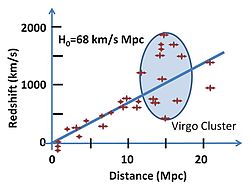
 Hubble's law can be easily depicted in a "Hubble Diagram" in which the velocity (assumed approximately proportional to the redshift) of an object is plotted with respect to its distance from the observer.[24] A straight line of positive slope on this diagram is the visual depiction of Hubble's law.


After Hubble's discovery was published, Albert Einstein abandoned his work on the cosmological constant, which he had designed to modify his equations of general relativity, to allow them to produce a static solution which, as originally formulated, his equations did not admit.[citation needed] He later termed this work his "greatest blunder" since it was his incorrect presumption of a static universe that had caused him to fail to accept what could be seen in his concepts and equations of general relativity:[citation needed] the fact that general relativity was both predicting and providing the means for calculating the expansion of the universe, which (like the bending of light by large masses or the precession of the orbit of Mercury) could be experimentally observed and compared to his theoretical calculations using particular solutions of the equations of general relativity as he had originally formulated them.

Einstein made a famous trip to Mount Wilson in 1931 to thank Hubble for providing the observational basis for modern cosmology.[citation needed]

The cosmological constant has regained attention in recent decades as a hypothesis for dark energy.[citation needed]


In cosmology, the Hubble volume, or Hubble sphere, is the region of the Universe surrounding an observer beyond which objects recede from the observer at a rate greater than the speed of light, due to the expansion of the Universe.[1]

The comoving radius of the Hubble sphere is c / H0, where c is the speed of light and H0 is the Hubble constant. More generally, the term "Hubble volume" can be applied to any region of space with a volume of order (c / H0)3.

The term "Hubble volume" is also frequently (but mistakenly) used as a synonym for the observable universe; the latter is larger than the Hubble volume.[2][3]

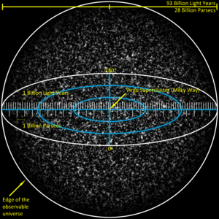
 Visualization of the three-dimensional large-scale structure of the universe in the Hubble volume. The scale is such that the fine grains of light represent collections of large numbers of superclusters. The Virgo Supercluster - home of our own galaxy - is at the center of our Hubble volume, but is too small to be seen in the image.


 Fit of redshift velocities to Hubble's law; patterned after William C. Keel (2007). The Road to Galaxy Formation. Berlin: Springer published in association with Praxis Pub., Chichester, UK. ISBN 3540725342.Various estimates for the Hubble constant exist. The HST Key H0 Group fitted type Ia supernovae for redshifts between 0.01 and 0.1 to find that H0 = 71 ± 2(statistical) ± 6 (systematic) km s−1Mpc−1,[21] while Sandage et al. find H0 = 62.3 ± 1.3 (statistical) ± 5 (systematic) km s−1Mpc−1.[22]

 A variety of possible recessional velocity vs. redshift functions including the simple linear relation v = cz; a variety of possible shapes from theories related to general relativity; and a curve that does not permit speeds faster than light in accordance with special relativity. All curves are linear at low redshifts. See Davis and Lineweaver.[25]


The discovery of the linear relationship between redshift and distance, coupled with a supposed linear relation between recessional velocity and redshift, yields a straightforward mathematical expression for Hubble's Law as follows:

v = H_0 \, D

where

  • v is the recessional velocity, typically expressed in km/s.
  • H0 is Hubble's constant and corresponds to the value of H (often termed the Hubble parameter which is a value that is time dependent and which can be expressed in terms of the scale factor) in the Friedmann equations taken at the time of observation denoted by the subscript 0. This value is the same throughout the universe for a given comoving time.
  • D is the proper distance (which can change over time, unlike the comoving distance which is constant) from the galaxy to the observer, measured in mega parsecs (Mpc), in the 3-space defined by given cosmological time. (Recession velocity is just v = dD/dt).

Hubble's law is considered a fundamental relation between recessional velocity and distance. However, the relation between recessional velocity and redshift depends on the cosmological model adopted, and is not established except for small redshifts.

For distances D larger than the radius of the Hubble sphere rHS , objects recede at a rate faster than the speed of light (See Uses of the proper distance for a discussion of the significance of this):


Make a free website with Yola