Gravity is the force which "pulls" an object back to earth. Understanding gravity is where my theory departs from modern gravitational theory.


In the context of classical theories of gravitation, the speed of gravity is the speed at which changes in a gravitational field propagate. This is the speed at which a change in the distribution of energy and momentum of matter results in subsequent alteration, at a distance, of the gravitational field which it produces. In a more physically correct sense, the "speed of gravity" refers to the speed of a gravitational wave.

The speed of gravitational waves in the general theory of relativity is equal to the speed of light in vacuum, c.[1] Within the theory of special relativity, the constant c is not exclusively about light; instead it is the highest possible speed for any physical interaction in nature. Formally, c is a conversion factor for changing the unit of time to the unit of space.[2] This makes it the only speed which does not depend either on the motion of an observer or a source of light and/or gravity. Thus, the speed of "light" is also the speed of gravitational waves and any massless particle. Such particles include the gluon (carrier of the strong force), the photons that light waves consist of, and the theoretical gravitons which make up the associated field particles of gravity (a theory of the graviton requires a theory of quantum gravity, however).


 Isaac Newton's analysis of escape velocity. Projectiles A and B fall back to earth. Projectile C achieves a circular orbit, D an elliptical one. Projectile E escapes.


In physics, escape velocity is the speed at which the kinetic energy plus the gravitational potential energy of an object is zero [nb 1]. It is the speed needed to "break free" from a gravitational field without further propulsion.

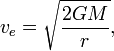
For a spherically-symmetric body, escape velocity is calculated by the formula

v_e = \sqrt{\frac{2GM}{r}},

where G is the universal gravitational constant (G=6.67×10⁻¹¹ m3 kg-1 s-2), M the mass of the planet, star or other body, and r the distance from the centre of gravity.


In this equation atmospheric friction or air drag, is not taken into account. A rocket moving out of a gravity well does not actually need to attain escape velocity to do so, but could achieve the same result at walking speed with a suitable mode of propulsion and sufficient fuel. Escape velocity only applies to ballistic trajectories.

The term escape velocity is actually a misnomer, as the concept refers to a scalar speed which is independent of direction whereas velocity is the measurement of the rate and direction of change in position of an object.

 In physics, a scalar is a simple physical quantity that is not changed by coordinate system rotations or translations (in Newtonian mechanics), or by Lorentz transformations or space-time translations (in relativity). This is in contrast to a vector. A related concept is a pseudoscalar, which is invariant under proper rotations but (like a pseudovector) flips sign under improper rotations.


Escape velocity is sometimes misunderstood to be the speed a powered vehicle, such as a rocket, must reach to leave orbit and travel through outer space. The quoted escape velocity is commonly the escape velocity at a planet's surface, but it actually decreases with altitude. It is the speed above which an object will depart on a ballistic trajectory, i.e. in free-fall, and never fall back to the surface nor assume a closed orbit. Such an object is said to "escape" the gravity of the planet.

A vehicle with a propulsion system can continue to gain energy and travel away from the planet, in any direction, at a speed lower than escape velocity so long as it is under power. If the vehicle's speed is below its current escape velocity and the propulsion is removed, the vehicle will assume a closed orbit or fall back to the surface. If its speed is at or above the escape velocity and the propulsion is removed, it has enough kinetic energy to "escape" and will neither orbit nor fall back to the surface.


Make a free website with Yola