Some people like a drink of wine.
So why would anyone want to put vodka in their wine?
What if it were Saki?
You can now order a saki (rice wine) and vodka, for the same price (as just a house wine) in any good establishment.
Of course you can also get a glass of house wine and a vodka for the same price.
Either pour the vodka into your wine (saki), or drink both straight. If you want fruit juice with it, (why would you?) you will have to pay the same price again.
Here's the good news; you get Edam cheese on a small round buscuit, such as a Griffins Snax. If you read this page you may know it sometimes also comes with a slice of ham and tartar sauce or mayonnaise.
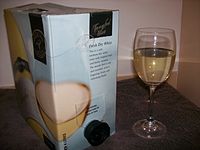
A 4 litre cask of Australian white wine
Frucor Just Juice Apple
So instantly popular was Just Juice when it was launched in 1981, that New Zealanders’ consumption of fruit juice almost trebled over the next three years!
Just Juice is just de goodness of tropical fruit. With no added sugar or preservatives, Just Juice is a delicious way to get one of your recommended fruit servings and 100% of your daily vitamin C!

Frucor Fresh Up Apple, Crisp Apple, Apple & Fejoa...etc
Just Juice was a breakthrough in technology when a way was discovered to make apple juice clear.
After 46 years Fresh Up, one of New Zealand’s top-selling fruit juice brands, is just as popular as ever. Fresh Up refreshes and revives sporty and outdoorsy Kiwis who love natural energy.
Available in a range of delicious, apple-based variants, Fresh Up is a crisp, refreshing fruit juice whose popularity knows no bounds.
Grape juice is obtained from crushing and blending grapes into a liquid. The juice is often sold in stores or fermented and made into wine, brandy, or vinegar. In the wine industry, grape juice that contains 7-23 percent of pulp, skins, stems and seeds is often referred to as "must". In North America, the most common grape juice is purple and made from Concord grapes while white grape juice is commonly made from Niagara grapes, both of which are varieties of native American grapes, a different species from European wine grapes. In California, Sultana (known there as Thompson Seedless) grapes are sometimes diverted from the raisin or table market to produce white juice.[1]
The method of pasteurizing grape juice to halt the fermentation has been attributed to an American physician and dentist, Thomas Bramwell Welch in 1869. A strong supporter of the temperance movement, he produced a non-alcoholic wine to be used for church services in his hometown of Vineland, New Jersey. His fellow parishioners continued to prefer and use regular wine. His son, Charles E. Welch, who was also a dentist, eventually gave up his practice to promote grape juice. In 1893 he founded Welch's Grape Juice Company at Westfield, New York. The product was given to visitors at international exhibitions. The oldest extant structure associated with the company is Welch Factory Building No. 1, located at Westfield, and listed on the National Register of Historic Places in 1983.[2]
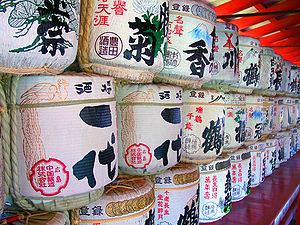
Sake is also referred to in English as a form of rice wine. However, unlike true wine, in which alcohol is produced by fermenting the sugar naturally present in fruit, sake is made through a brewing process more like that of beer, thus it's more like a rice brew than a rice wine. To make beer or sake, the sugar needed to produce alcohol must first be converted from starch. However, the brewing process for sake differs from beer brewing as well, notably in that for beer, the conversion of starch to sugar and sugar to alcohol occurs in two discrete steps, but with sake they occur simultaneously. Additionally, alcohol content also differs between sake, wine, and beer. Wine generally contains 9–16% alcohol[1] and most beer is 3–9%, whereas undiluted sake is 18–20% alcohol, although this is often lowered to around 15% by diluting the sake with water prior to bottling.
You can find out more about the history of wine here.
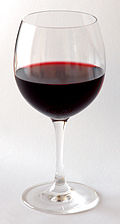
Wine is an alcoholic beverage, made of fermented fruit juice, usually from grapes.[1] The natural chemical balance of grapes lets them ferment without the addition of sugars, acids, enzymes, or other nutrients.[2] Grape wine is produced by fermenting crushed grapes using various types of yeast. Yeast consumes the sugars in the grapes and converts them into alcohol. Different varieties of grapes and strains of yeasts produce different types of wine.
Wines made from other fruits, such as apples and berries, are usually named after the fruit from which they are produced (for example, apple wine or elderberry wine) and are generically called fruit wine or country wine (not to be confused with the French term vin de pays). Others, such as barley wine and rice wine (i.e., sake), are made from starch-based materials and resemble beer and spirit more than wine, while ginger wine is fortified with brandy. In these cases, the term "wine" refers to the higher alcohol content rather than the production process.[3] The commercial use of the English word "wine" (and its equivalent in other languages) is protected by law in many jurisdictions.[4]
Wine has a rich history dating back thousands of years, with the earliest known production occurring around 8,000 years ago on the territory of modern-day Georgia.[5][6] It first appeared in the Balkans at about 4500 BC and was very common in ancient Greece, Thrace and Rome. Wine has also played an important role in religion throughout history. The Greek god Dionysus and the Roman equivalent Bacchus represented wine, and the drink is also used in Christian Eucharist ceremonies and the Jewish Kiddush.
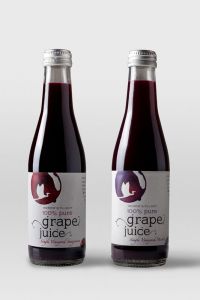
Welch Foods Inc. (Welch's) is an American company, headquartered in Concord, Massachusetts. It is owned by the National Grape Cooperative Association, a co-op of grape growers.
Welch's grape and strawberry soda flavors are currently licensed to the Dr Pepper Snapple Group.[4] Other popular products that use the Welch's name are the fruit snacks made by The Promotion In Motion Companies, Inc.
Dr Pepper Snapple Group Inc. (formerly Cadbury Schweppes Americas Beverages) is an American soft drink company, based in Plano, Texas.
It was spun off from Britain's Cadbury Schweppes, on May 5, 2008, with trading in its shares starting on May 7, 2008. Cadbury Schweppes plc became Cadbury plc on May 5, 2008.[2][3]

A socket wrench is a wrench with interchangeable heads called sockets that attach to a fitting on the wrench, allowing it to turn different sized bolts and other fasteners. The most common form is a hand tool popularly called a ratchet consisting of a handle with a ratcheting mechanism built in, so it can be turned using a back-and-forth motion in cramped spaces. A socket has a cup-shaped fitting with a recess that grips the head of a bolt. The socket snaps onto a male fitting on the handle. The handle supplies the mechanical advantage to provide the torque to turn the socket. The wrench usually comes in a socket set with many sockets to fit the heads of different-sized bolts and other fasteners. The advantage of a socket wrench is that, instead of a separate wrench for each of the many different bolt heads used in modern machinery, only a separate socket is needed, saving space.
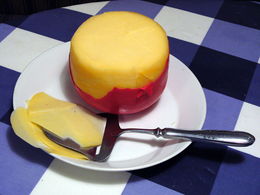
Edam (Dutch Edammer) is a Dutch cheese traditionally sold in spheres with a pale yellow interior and a coat of red paraffin wax. It is named after the town of Edam in the province of North Holland,[1] where the cheese is coated for export sale and for the tourist high season.
It is also the most common cheese used in the popular snack in the Czech Republic (Czech: smažený sýr) and Slovakia (Slovak: vyprážaný syr)[8] where it may be served with a slice of ham (Slovak: so šunkou),[9] and always with tartar sauce (tatárska omáčka) or mayonnaise. In the Philippines, it is named queso de bola, and is especially popular during Christmas season, served with hamon during the midnight meal (nochebuena).[10]
The history of Chinese grape wine has been dated back more than 4,600 years. In 1995, a joint Sino-USA archeology team including archaeologists from the Archeology Research Institute of Shandong University and American archaeologists under the leadership of Professor Fang Hui (方辉) investigated the two archaeological sites 20 km to the northeast of Rizhao, and discovered the remnants of a variety of alcoholic beverages including grape wine, rice wine, mead, and several mixed beverages of these wines. Out of more than two hundred ceramic pots discovered at the sites, seven were specifically used for grape wine. Remnants of grape seeds were also discovered.[2]
If grape wine consumption was once common in Bronze Age China, however, it died out completely in ancient times, and was replaced by consumption of a range of traditional Chinese alcoholic beverages made from sorghum, millet, rice, and fruits such as lychee or Asian plum. It was not until the Han Dynasty that the ancient Chinese became reacquainted with the consumption of grape wines (via Central Asia), and not until the Tang Dynasty that consumption of these wines became common.
French wine was the first foreign wine imported into China. In 1980, at the beginning of Chinese economic reform, Rémy Martin ventured into China to set up the first joint-venture enterprise in Tianjin: the Dynasty (Wang Chao, 王朝) Wine Ltd., which was also the second joint-venture enterprise in China. Over the years, the company developed over 90 brands of alcoholic beverages, and its products won numerous awards both domestically and abroad.
Rémy Martin (French pronunciation: [ʁemi maʁtɛ̃]) is a brand selling cognac (a brandy from the Cognac region of France), specialist of the Cognac Fine Champagne originally produced by Rémy Martin, a French winemaker, who founded the company in 1724. It is now owned by Rémy Cointreau, a company founded in 1991.